Oh boy...this is my jam! I am a full nerdy academic type, so I love nothing more than having a pen and notebook in my hand, taking notes furiously as I LEARN, LEARN, LEARN something new, or often, some new, delicious perspective on something that gives it (and me) new life and fire.
Svadhyaya is the Yogic path, a sacred path, of self-study and reflection. You don't have to be an academic to pursue this path. This path is all about really stopping to think and reflect on your perspectives and to learn, listen and read as much as you possibly can to inform this, not because you have to, but because you desire to. This practice helps you to really discern information, to practice critical thinking, to examine different perspectives and viewpoints instead of just acting or believing impulsively from a limited perspective or experience. YES!!!
This is not always pleasant, because it requires deep digging. This would be Socrates' favorite Yoga Niyama, I think, because it's all about questioning everything, not taking anything you think you know for granted, but truly knowing it in your heart and soul because you've REALLY reflected on it, wrestled with it, churned it and made it yours. This helps us see more clearly, authentically and with that "engaged detachment" that Buddhists like to talk about.
Of course, we want to be mindful not to get so obsessed with our head's learning that we forget our heart's connection (a constant check for most of us academics, I think). Svadhyaya is not about being Mr. Know-It-All, it's about helping us better investigate what and why we see things the way we do, to understand and appreciate how others do the same and to hone our strengths and be honest about the aspects we need to work on.
Gandhi said it was our "sacred duty" to study all of the world's wisdom scriptures. He read from the New Testament, the Qu'ran and the Bhagavad Gita daily. Lately, I've been in a spirit-led devouring of religious scripture. I just can't get enough. I'm scribbling notes and diving deep, reevaluating a lot of what I've assumed in the past. It's a bit scary. It's weird at times. But it's so, so good. And so joyful.
Everyone in my area is aware of, or has been directly impacted by the multiple tornadoes that hit our area last week. We've all been recovering, either physically or emotionally/spiritually (or both). It is truly miraculous that with all of the destruction, there was such little impact to human life. Most of what is being dealt with now is the material loss and starting over. According to the scriptures I've been reading lately, this is a time for us to be grateful and for us to act. To serve as God's hands and HELP however we can. From the smallest gesture/token to grand ones, we are all in this.
"(Because of this distress)...you're more alive, more concerned, more sensitive, more referent, more human, more passionate, more responsible...you've come out of this with purity of heart." 2 Cor.7:9-13
"Blessed is the one who perseveres under trial." James 1:12
"I pray that from his glorious, unlimited resources he will empower you with inner strength through his Spirit." Ephesians 3:16
"Love your neighbor as you love yourself." Matthew 22:39

Thursday, June 6, 2019


Thursday, May 23, 2019
Niyamas: Self-Discipline (Tapas)
Our next Niyama is Tapas or Self-Discipline. So, this is basically...the hard part. We often have great intentions, great ideas (think - New Year's Resolutions), but then we get busy, distracted, let our negative inner voices (that's stupid, you can't do that, no one cares) win...or we just plain get exhausted by life and lose our gumption.
Say it slowly - "through committed discipline...we remove impurities...and strengthen...our personal...power." I LOVE this.
Tapas translates as "to purify" or "to burn" through heat. Think of a really awesome workout or hike you did, where you pushed yourself and burned through, feeling like a superhero on the other side. Or think of a time you did this at work, through a big, impactful project or during a personal, creative endeavour - burning through with the results beyond what you ever imagined.
Tapas is about the LONG TERM. The short term will almost be guaranteed to be uncomfortable, vulnerable or downright painful. This takes balance - we want a healthy edge to strengthen ourselves and push ourselves outside comfort boundaries, but we don't want to push so far that we fall off the metaphorical (or perhaps literal) cliff and injure ourselves (physically, spiritually, mentally, etc.).
So, how do we begin tapas? Make a goal. This can be physical health, emotional health, spiritual health, mental health or it can be anything. Make the goal. Write it down. Say it out loud. Then, start planning the smaller steps to get there. Steps that may even seem questionable to include. Include them. This is about the focus on one small decision/action at at time.
The example I will give is one my own. During the past month with classes ending, I've started setting aside time each day for self-study, the jnana path (which we'll discuss more next niyama!). I've been reading and reflecting on several books and scriptures each day, writing down what speaks to me, what makes me think and reflect. I sit in the knowledge, meditate on it, and use it as a foundation for daily prayer.
Now, this kind of scripture/text reading is something I've participated in before, in isolated bursts of spiritual good intention, but not usually consistently as a daily practice.
What...a...difference...as a daily...practice. When you make it a discipline. When you make the choice to take a half hour for self-study instead of reality TV or Facebook scrolling. Consider this:
From the Yoga Sutras (2:43) - Kayendriya-siddhir ashuddhi-kshayat tapasah or "Through committed discipline we remove impurities and strengthen our personal power."
Say it slowly - "through committed discipline...we remove impurities...and strengthen...our personal...power." I LOVE this.
Tapas translates as "to purify" or "to burn" through heat. Think of a really awesome workout or hike you did, where you pushed yourself and burned through, feeling like a superhero on the other side. Or think of a time you did this at work, through a big, impactful project or during a personal, creative endeavour - burning through with the results beyond what you ever imagined.
Tapas is about the LONG TERM. The short term will almost be guaranteed to be uncomfortable, vulnerable or downright painful. This takes balance - we want a healthy edge to strengthen ourselves and push ourselves outside comfort boundaries, but we don't want to push so far that we fall off the metaphorical (or perhaps literal) cliff and injure ourselves (physically, spiritually, mentally, etc.).
So, how do we begin tapas? Make a goal. This can be physical health, emotional health, spiritual health, mental health or it can be anything. Make the goal. Write it down. Say it out loud. Then, start planning the smaller steps to get there. Steps that may even seem questionable to include. Include them. This is about the focus on one small decision/action at at time.
The example I will give is one my own. During the past month with classes ending, I've started setting aside time each day for self-study, the jnana path (which we'll discuss more next niyama!). I've been reading and reflecting on several books and scriptures each day, writing down what speaks to me, what makes me think and reflect. I sit in the knowledge, meditate on it, and use it as a foundation for daily prayer.
Now, this kind of scripture/text reading is something I've participated in before, in isolated bursts of spiritual good intention, but not usually consistently as a daily practice.
What...a...difference...as a daily...practice. When you make it a discipline. When you make the choice to take a half hour for self-study instead of reality TV or Facebook scrolling. Consider this:
"Self-respect is the root of discipline. Our sense of dignity grows with the ability to say no to oneself." - Abraham Joshua Heschel, Jewish Theologian/Philosopher
Whenever I pick up the phone and begin to mindlessly scroll, I can look to this bit of wisdom - it's good sometimes to say no to the short term in order to cultivate long term nourishment. This is a small act of discipline that can make a huge affect in the long run.
I recently read this verse from the Hebrew Bible: "His word burns in my heart like a fire...It's like a fire in my bones." (Jeremiah 20:9) This resonates with me so much right now - this thirst for knowledge and connection, this JOY and gratitude for this practice, I feel it like a fire burning. My love for God and for this spiritual practice is like a fire in my bones. And like Jeremiah goes on to say, I can't shut it out! I don't want to.
Namaste, Amen, and see you in a couple of weeks for our next Niyama!
Monday, May 6, 2019
Niyamas: Santosha (Contentment)
Santosha is about feeling at peace - feeling truly happy in this moment. This is our second Niyama.
I have been in a passionate immersion lately where I am devouring every single spiritual/religious book I can get my hands on - Buddhist, Christian, Muslim, Yogic, you name it. This is something I do all the time by the nature of my profession as an academic who teaches religion.
However, this has been different - because it's propelled fully by my heart, not just academic knowledge. I'm fascinated by the similarities of Jesus' teachings and Buddha's, of Biblical texts and Zen teachings. I feel ravenous, thirsty for understanding and knowledge. But, in my heart, I am feeling unusually content - that despite this overwhelming desire to know, know, know through spiritual study, I feel, somehow, surprisingly, that I am exactly where I am supposed to be in this journey. I certainly don't always feel this way. But, I do right now, so I am reveling in that space, that quiet stillness, that joy and gratitude of contentment.
I attended a Sunday morning Tibetan Buddhist teaching yesterday. The focus was on (as always in Buddhism :), impermanence. "This too shall pass." Most of our sorrow, worry, anxiety are caused by our illusions (maya) in thinking that we can hold onto things - further, our illusion that they are permanent. The truth of reality is: Everything changes. Contentment is not just the realization of this constant flux, but embracing it. The wonderful Tibetan monk, who I just love, described the "demons" we struggle against - demons of ego, illusion, greed, clinging, etc. While these often get turned into manifested beings/evil forces in many religions, I am more drawn to think of them as colorful descriptions of affliction. I also immensely enjoy the way the monk pronounces it: "Daa-mon" like Matt Damon, so much so, that every time he said it, I began silently thinking, "the Matt Damon of ignorance, the Matt Damon of clinging, etc."
Patanjali (author of the Yoga Sutras, the first established canon of Yoga writings) said that if we accept where we are RIGHT NOW, in this moment, and second, understand things WILL CHANGE, then we will find true joy.
One of my favorite authors is Anne Lamott. She says prayers often take three forms: Help, Thanks, and Wow. The thanks is the focus here with santosha. Gratitude. Look around. Be here. Take it in. Breathe in. Breathe out. Say, "Thank you."
I have been in a passionate immersion lately where I am devouring every single spiritual/religious book I can get my hands on - Buddhist, Christian, Muslim, Yogic, you name it. This is something I do all the time by the nature of my profession as an academic who teaches religion.
However, this has been different - because it's propelled fully by my heart, not just academic knowledge. I'm fascinated by the similarities of Jesus' teachings and Buddha's, of Biblical texts and Zen teachings. I feel ravenous, thirsty for understanding and knowledge. But, in my heart, I am feeling unusually content - that despite this overwhelming desire to know, know, know through spiritual study, I feel, somehow, surprisingly, that I am exactly where I am supposed to be in this journey. I certainly don't always feel this way. But, I do right now, so I am reveling in that space, that quiet stillness, that joy and gratitude of contentment.
I attended a Sunday morning Tibetan Buddhist teaching yesterday. The focus was on (as always in Buddhism :), impermanence. "This too shall pass." Most of our sorrow, worry, anxiety are caused by our illusions (maya) in thinking that we can hold onto things - further, our illusion that they are permanent. The truth of reality is: Everything changes. Contentment is not just the realization of this constant flux, but embracing it. The wonderful Tibetan monk, who I just love, described the "demons" we struggle against - demons of ego, illusion, greed, clinging, etc. While these often get turned into manifested beings/evil forces in many religions, I am more drawn to think of them as colorful descriptions of affliction. I also immensely enjoy the way the monk pronounces it: "Daa-mon" like Matt Damon, so much so, that every time he said it, I began silently thinking, "the Matt Damon of ignorance, the Matt Damon of clinging, etc."
Patanjali (author of the Yoga Sutras, the first established canon of Yoga writings) said that if we accept where we are RIGHT NOW, in this moment, and second, understand things WILL CHANGE, then we will find true joy.
One of my favorite authors is Anne Lamott. She says prayers often take three forms: Help, Thanks, and Wow. The thanks is the focus here with santosha. Gratitude. Look around. Be here. Take it in. Breathe in. Breathe out. Say, "Thank you."
Monday, April 29, 2019
Niyamas: Saucha (Purity)
Just a bit of a gap since the last Yama! I was very blessed to discover I was pregnant after the last blog. With three daughters to raise and professional milestones/tenure to attain, the blog slipped through my fingertips in the whirlwind of life. After several pregnancy and infant-hazed months...and then, parenthood...with like...multiple children...I just let it go. And that was okay.
That was a nice run, I thought.
But, there's some magic in the air. I felt inspired to write again. It is never too late to start again. I am as passionate about Yoga, religion, and spirituality as ever and feel like delicious, juicy layers have been unfolding in these years of motherhood I never imagined possible a decade ago.
So, let's leap right in and pick up where we left off: the Niyama of Purity. This is one of the inner observances. Beyond the obvious cleaning up your environment and your physical self - which, let's not underestimate the power of this - it's a focus of inner scrubbing. Simplify. Let go of that which you no longer need or which clutters up your life, physically or emotionally. A key factor to this is becoming aware (practicing discernment) of what may be causing toxicity or negativity in your life.
This takes pause, reflection and a hard look. It's about getting back to the core of who you are. It makes me think of Michaelangelo's philosophy when sculpting - that he was never creating an image, but just releasing the image from the block of stone, scraping away all that "was not the horse" or "was not David" to reveal...well, the horse or David.
Saucha is about revealing our inner David. We do this by starting to scrape away that which covers up who we really are. What a perfect goal as the semester ends and summer's warmth and expansion beckons. As I finish up grading, closing up the books and ending an exceptionally fulfilling term, as professionally (and soulfully, in many cases) as they've been, I'm ready to let go of those specific aspects of obligation and focus now on the core of myself - as a mother, as a Yogi, as a seeker. I'm interested in spiritual nourishment. I'm ready to let go of that which doesn't make my soul sing or my heart full. I'm ready for some Svadhyaya (self-study) and to be a fully present, hands free Mama to my girls. I send a prayer up that it will be a glorious summer.
Next up: Santosha (Contentment).
Namaste beautiful people!
Thursday, July 24, 2014
Yamas: Aparigraha
Aparigraha translates as non-grasping or non-hoarding. It’s also about spreading the love and good
fortune. It’s about not holding on to
that which binds you. On a material
level, this was perfect timing as we were in the process of weeding out,
organizing and getting rid of stuff for our yard sale.
I LOVE this process and always have. There is something so freeing about just
getting rid of anything that is cluttering up your living space. It’s a very Buddhist process, constantly
asking yourself, “How attached to this am I?
Do I really need this?” I applied
the one year rule (if you haven’t used it/wore it in a year, get rid of it
philosophy) and realized that there were several things that I had already
asked myself about years before and kept, so they got the boot.
One thing that was particularly liberating to me was letting
go of books I had carried with me for over 20 years. Books that meant something so big to me at
18, 22, 25, book like Kerouac’s Dharma
Bums, some Jim Morrison poetry, etc.
I’ve been carrying them, moving them from apartment to apartment, house
to house, for almost two decades, because they had meant SO MUCH to me
then. I looked at them and realized,
they had meant so much to me, defined
my young, burgeoning identity, made a statement about who I was. But they’ve
given me what they needed and I don’t need to continue carrying them. Like Buddha’s story of the raft – he says,
use the raft - it can help you get across, but once you’re across the river,
why are you carrying that raft around on your back?
Yogis and Buddhist have long said though, it isn’t the
stuff, the materialism that is bad or evil.
Not at all. There’s nothing wrong
with stuff, or even having stuff. It’s
our illusions and attachments to this stuff, that somehow these material things
will make us happy, fill a void, etc.
When we attach ourselves to so much stuff and our lives and living space
becomes cluttered, so will our hearts and minds, according to Feng Shui
principles.
Aparigraha also applies to not attaching mentally, not ruminating, as a psychology teacher
recently said on a conference. This is
a big practice for me. There are certain
issues and particular people that I ruminate about constantly. This is holding on, hoarding thoughts,
grasping. And all it does is cause a big
ugly knot in my soul and gut. It was
much easier to clean out the garage.
So, this is about cleaning out the garage of your mind and soul, getting
the poison out. This is the most
important practice, of course. But I’m
still working on it. Constantly.
The notion of simplifying has been in the forefront of my
mind lately and I am putting it into practice as much as I can. Less is more.
Simplicity is key. Aparigraha was
the last Yama and now that we’ve practiced the five restraints (or don’ts), now
we move on to the Niyamas, the observances (or do’s).
Sauca (purity) is next!
Wednesday, June 4, 2014
Yamas: Chickens! (Brahmacharya - Moderation)

Brahmacharya is defined usually as celibacy in the four stages tradition, the phase of life a young man (though many now include young women too - hizzah!) goes through to experience a monk-like existence. While most of our American boys are drinking and having (or trying to have) sex, the ideal Hindu adolescence includes complete devotion to a guru and an immersion into spiritual discovery. Not that this is always the case, but it truly will make an Indian mama proud if her son does follow this highly venerated route.
But brahmacharya is more than celibacy, it is about moderation. It is about balance, simplifying and preserving our energy. Satchidananda describes it best when he says, "Through Brahmacharya, we save our virya, our vital energy." This couldn't speak to me more. With kids, a mortgage, a full time job and a new homestead (which will come next!), I am all about saving my vital energy. It's really vital, as it turns out...
According to Satchidananda, this Yama is all about our awareness and practice of giving and receiving in balance, of learning to say "no" when things aren't healthy or productive for us, and saving our "yes" for when it truly increases our chi exchange. He uses an example of loving our child. "You would not give a child an entire box of candy to show our love, would you? You would give a small piece or two." I always loved how Satchidananda used practical examples to explain sometimes extremely esoteric concepts. He was Christ-like in that way.
The Budda, Jesus, Aristotle, Marcus Aurelius - they all spoke volumes about the benefits of moderation, indeed our happiness depends on it, according to most in that list.
So, how did I practice moderation this month? In a few ways. For one, I decided to take a digital vacation for almost two weeks to clear my mind and mental space and focus on other things. No work email, no facebook, nothing. It was a delicious recharging, one I need to do more often. But, I'm going to focus on the chickens. The chickens were my moderation teachers!
They arrived at the post office early in the morning and I got the call I had been waiting for at 7 a.m. At 7:08, Bodhi and I arrived and pulled up to the back porch of the small office (I felt special :D) and the worker handed me a tiny box full of peep peeps and I said, "Is there another box?" There couldn't possibly be 15 chickens in this tiny shoebox sized package. "Nope," she said, "that's it!"
Still doubtful, I drove home, excitedly listening to the tiny little peeps coming from this package. In the garage, I opened up the box and saw a small fur ball in one corner - all of the chicks were huddled together so tightly, they didn't even take up a fourth of the box. I slowly took out one at a time to put in the brooder under the heat bulb, examining them and counting them and gushing over them (little tiny babies!). And surprisingly enough, all 15 were there, healthy and alive, thank goodness.
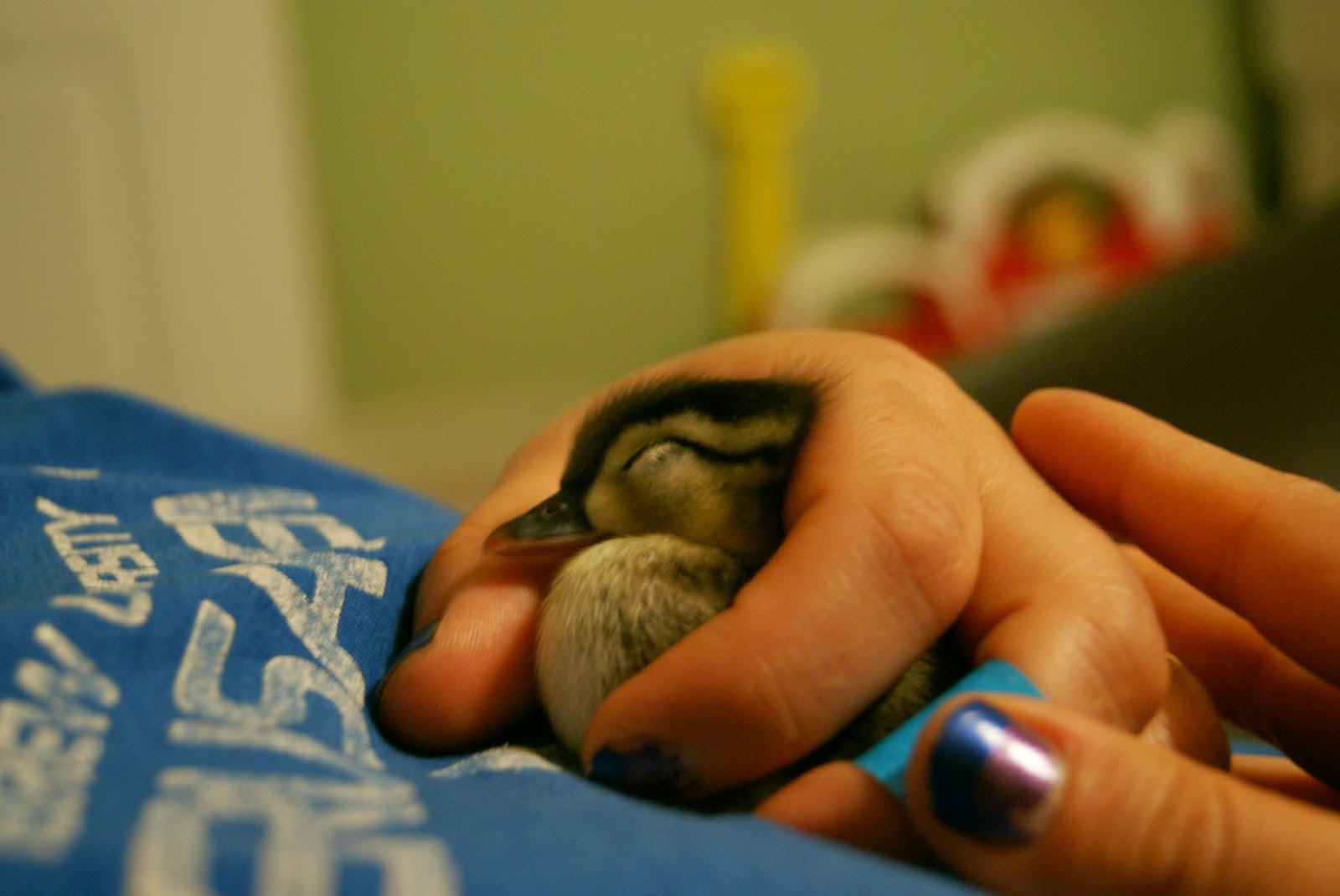
About an hour after getting the chicks settled in, my good friend called me, "So...we have this baby duck that just wandered into our yard and we don't really have anything to keep it alive." A quick call to Jimmy and 15 minutes later, Caitlin showed up with the tiniest duck I have ever seen. It was even cuter than the chicks! Since we had the extra brooder for when the chicks get bigger, I made the duck a temporary home until we could figure out another set up for him.
We already thought it a pretty exciting day, and then later that afternoon a tornado came through the farm field behind our back yard. Nothing humbles you and makes you put things in perspective more than learning that the 70-year-old farm house a half mile from your own house has been demolished. Three generations of family had lived there (they were safe in their basement thankfully, dug out by rescuers shortly after the collapse). Their house was gone, their barns ripped apart, their silos bent in like slinkys. On days like this, you realize getting upset over a high electricity bill or getting irritated at the slow worker at Subway (both things I was guilty of earlier that day) really shouldn't take any of your energy.
And here's what Brahmacharya comes back to - what you give your vital energy to. How can I simplify things to still be effective, beneficial, but without sacrificing more energy than I need or want to? This definitely isn't about multi-tasking which is really pretty counter intuitive to most Buddhist and Yoga philosophies, it's about discernment and prioritizing. It's about knowing who you are and where you want your exchanges to be.
The chickens doubled in size by day 3, tripled in size by the weekend and I swear, quadrupled in size by the day after that! The newly hatched fluffs of fur that fit in my palm that first morning were now awkward little pin-feathered birds, looking somewhere between a petite, majestic eagle and gangly junior high kid. Taking care of them became a ritual, a farming ceremony, one I looked forward to. Changing their waters (which they mucked up almost immediately afterwards, reminding me of how cats love for you to change the litter so they can promptly take a big, smelly dump in them, as if to say, "Thanks, I was waiting on you to do that."), filling their food containers, adding fresh pine shavings, then of course taking out a few to pet and hold and "bond" with.
The first two weeks, we did this routine twice a day with two brooders, but by week 3, we had to split up the chickens into their two brooders and makeshift a third duck pad for our tailfeathered friend that Jimmy had now bestowed the name, Little Lord Ticklebottom. Best...duck...name...ever.
Add to this constantly adjusting the heat lamps that hang over them. The first week, like a new nervous mother with a newborn, I constantly checked the thermometers in the brooder, adjusting the heat lamp levels and bulb strengths as it got too hot or too cold. By the third week when the temperatures could be around 10 degrees lower, I felt much more comfortable winging it (heh) and just going by whether they were against the sides of the tub (too hot), huddled together in a fur blanket (too cold) or comfortably hanging out around the space (perfect temperature).
More than anything, the constant regulation of temperature has been a great reminder of moderation, of Aristotle's warning that happiness comes from the perfect golden mean, from neither excess or deficiency.
I have rolled out my Yoga mat exactly twice this month. Some might say that I did not follow moderation because of this, since I was lacking in my normal "practice." But having a break from commuting from campus (our "summer" break was during the last couple of weeks) has put me in a different routine. Spending most of my days being with Bodhi, planting and tending our gardens, landscaping, digging and planting trees, mowing, and taking care of the chickens and duck became my Yoga. It has been a sweet, natural, mindful Yoga that has made me present every single day, has made me connected to my land and my animals. I have breathed and stretched and focused during all this work in building and starting our little farmstead and in spending so much time with Bodhi. At the end of each day, I am sore from all the physical labor and tired from being with an almost two-year-old all day, but in a good, happy way, content, peaceful and centered.
The truth is, for last couple of weeks, I haven't felt like I needed my asana practice, like I do so strongly when I have spent a day working in the office, teaching in front of groups of students and commuting. Even though I truly love my career and teaching, it is a fact that on those days, I can't wait for the evening to roll out my mat and unwind from the day.
But, I'm learning during this headfirst dive into our little farm, that I don't feel a need to unwind after a day spent with my hands in the dirt and chickens in my palms. I don't need to unroll the mat after the stretching I've done hanging clothes on the clothesline, planting and building the chicken run. I don't need to do a special seated meditation after spending the mornings and evenings performing the rituals that have become second nature. They are my meditation right now. I am certain my separation from my mat is only temporary and that there will soon be days when I go back to work or deal with the insurance company or some other stressful occasion, that I will come back to my mat with vigor and re-dedication.
But for now, I'm just going to feed the chickens and Mr. L.L. Ticklebottom and watch them grow with Yogic gratitude.
Friday, May 2, 2014
Yamas: Asteya (Nonstealing)
This month was HARD. Not in practicing asteya, but in the fact that it is the last month of the semester, which always creates chaos, stress, anxiety, imbalance and an overall feeling of things falling through the cracks. On top of this, many other life factors came into play, making this month a whirlwind. I did my best. Or pretty close to it.
April 4th - Asteya is defined as non-stealing. This is not only a caution against stealing things that aren't yours, but stealing time, energy, trust, etc. It takes stealing to a whole deeper level. So far, I haven't had any trouble not stealing people's stuff (not something I was accustomed to doing before), but I have been paying attention of any way I may unknowingly steal people's time or energy.
In doing this, I became VERY aware of how others may try to steal my time and energy (and money). Long phone calls and wait times to a payment system that made an error on my mortgage payment (so much time (and money!) stolen...) Acquaintances that tend to take and take and not give in return. It's a hard balance to give and not be taken advantage of.
April 5th - A tiny three month old kitten came to our doorstep last night. He is a bag of bones, wheezing like Darth Vader and just all around pathetic. I instantly fell in love with him. I'm really hoping we can keep him. He is so affection and loving and sweet.
April 7th - Bad news. The kitten tested positive for Feline Leukemia. I'm overwhelmed. I've had four cats in my life and never have had any experience with this. It's pretty scary and not at all promising. The vet said the prognosis isn't great, but that there's a chance he could just be exposed and "grow out of it" later. But then the pamphlets said that babies and elderly shouldn't be around Fel-V cats because of other stuff they can pick up due to their suppressed immune systems. I don't know what to do.
April 16th - Today at Kroger, I bought a cart full of groceries, got out to the car, exhausted after working all day. Bodhi was kicking and crying, also tired from the long shopping excursion. I realized there was a bag of red potatoes next to her in the child seat. I hadn't seen it and neither had the cashier when I checked out. I was so tired and at first thought, screw it. But then, I knew this was a perfect opportunity to make a choice to practice Asteya.
With Bodhi pouting and whining, I pushed her and the cart back into the store and went up to the cashier with the potatoes and receipt in hand. She looked annoyed at me at first. I told her what happened and she didn't have any reaction, but just charged my card again and I wondered to myself if this was even worth it. Then she said, "Thank you for being so honest." And I stumbled, "Oh, no problem." But if I'm being completely honest, I'm not sure if I would have gone back in if I wasn't doing this Yama practice. And that is something for me to reflect on. This kind of small "free-bee" thing has happened probably a dozen times in my life and I'd say about half of those times, I have made the effort to take back the item. When I haven't, I usually make the "big corporation won't miss a couple of dollars" argument. But the thing is, that's not the point. It's karma. It's not stealing. And I have to admit, I felt better after paying for the potatoes.
April 28th - I used to have a really bad habit of being late all the time. And who am I kidding, I still struggle with this, especially with kids, though I make a much more mindful attempt not to be late now. One thing I am always on time for is work and my classes. Always. I leave extra early just to make sure because I struggle with this. There is a student this semester that I've been putting aside special time for because she is struggling in class. We've met three times outside of class and each time she has been 15-20 minutes late for our appointment, always with what seems like a legitimate excuse. Today, I was due to meet her at 3:00 and I myself was running just a few minutes behind with dropping Bodhi off. Considering her consistent late arrival, I figured I would still likely make it there before she would. I arrived exactly at 3:03 p.m. and she was in the main office, asking my chair (boss!) where I was. Seriously. Ugh. Back in my 20s, I never looked at being late as stealing people's time, but now I do. It is something I try to avoid if possible. But sometimes, it is unavoidable.
April 30th - I've been taking care of the kitten for this whole month, giving him antibiotics, food, tons of love and trying like crazy to find him a home to no avail. He is the sweetest little soul and rubs up against me ferociously as if he is saying, "Oh, thank you, thank you." His respiratory infection hasn't improved much. So, I took him into a different vet for a "second opinion" and follow up test.
As we were waiting for the results, the vet and the tech informed me of the suffering and pain involved with Fel-V and that the reason his respiratory infection wasn't getting better was probably because he was already very sick with his weakened immune system. Normal kittens would recover with such a strong round of antibiotics. While he had gotten better at first it seemed, his wheezing now returned and it was pretty difficult for him to breathe. We talked for a few minutes and I said, "What do I do if this test is positive?" He looked at me compassionately, but confidently said, "I would strongly encourage putting him down, for his sake and yours." During those next couple of minutes waiting, I prayed, Please be negative, please be negative. I petted him and I said to him, "Come on, be negative, kitty, you can do it."
The vet walked back in and I knew the result from the look on his face. "It's positive. A strong positive." He explained that this second test confirms that the kitten definitely absolutely has it and that it's not just an "exposure" thing that may go away. I burst into tears, blubbering all over the place. The vet tech looked at me compassionately, "Take the money you would put into him for the next few weeks and adopt a healthy cat and then donate to the shelter to help 15 cats, you must realize that anything you do for him, he's not going to last very long." They gave me a few moments and were very kind and yet, clear and validating, which I appreciated.
I cried as I petted him. I couldn't believe how emotionally attached I had become to him. He was so special, so sweet, so loving, so little. And so sick. I cried and said over and over, "I am sorry, I am so so sorry." I felt like I had failed him. He had came to us for help, so little and pathetic, and now this was happening. I cried as much for him as I did when my cats of 16 and 17 years died. Mourned just as deep and just as rough. Even more so in some ways with him being so young. It was so unfair. It wasn't his fault. His life was just stolen from him from a terrible disease most likely given to him through birth. The silver lining of his death according to the vet tech is that by us taking him "off the market" as a boy cat out in the woods, we probably saved many cats from getting infected. That makes me feel a little better. But I still feel really awful. I miss his little face and wheezy purr.
Between this and a friend of mine's recent devastating loss (which I won't write about here for sake of her privacy), Asteya has been a difficult month. I hope May (Brahmacharaya - moderation) is a little more light, a month full of life and fun and sun. Moderation in everything. After the extremes of this month and feeling overwhelmed ALL the time, I am game for moderation. The Buddha's path. Let's do it.
April 4th - Asteya is defined as non-stealing. This is not only a caution against stealing things that aren't yours, but stealing time, energy, trust, etc. It takes stealing to a whole deeper level. So far, I haven't had any trouble not stealing people's stuff (not something I was accustomed to doing before), but I have been paying attention of any way I may unknowingly steal people's time or energy.
In doing this, I became VERY aware of how others may try to steal my time and energy (and money). Long phone calls and wait times to a payment system that made an error on my mortgage payment (so much time (and money!) stolen...) Acquaintances that tend to take and take and not give in return. It's a hard balance to give and not be taken advantage of.
April 5th - A tiny three month old kitten came to our doorstep last night. He is a bag of bones, wheezing like Darth Vader and just all around pathetic. I instantly fell in love with him. I'm really hoping we can keep him. He is so affection and loving and sweet.
April 7th - Bad news. The kitten tested positive for Feline Leukemia. I'm overwhelmed. I've had four cats in my life and never have had any experience with this. It's pretty scary and not at all promising. The vet said the prognosis isn't great, but that there's a chance he could just be exposed and "grow out of it" later. But then the pamphlets said that babies and elderly shouldn't be around Fel-V cats because of other stuff they can pick up due to their suppressed immune systems. I don't know what to do.
April 16th - Today at Kroger, I bought a cart full of groceries, got out to the car, exhausted after working all day. Bodhi was kicking and crying, also tired from the long shopping excursion. I realized there was a bag of red potatoes next to her in the child seat. I hadn't seen it and neither had the cashier when I checked out. I was so tired and at first thought, screw it. But then, I knew this was a perfect opportunity to make a choice to practice Asteya.
With Bodhi pouting and whining, I pushed her and the cart back into the store and went up to the cashier with the potatoes and receipt in hand. She looked annoyed at me at first. I told her what happened and she didn't have any reaction, but just charged my card again and I wondered to myself if this was even worth it. Then she said, "Thank you for being so honest." And I stumbled, "Oh, no problem." But if I'm being completely honest, I'm not sure if I would have gone back in if I wasn't doing this Yama practice. And that is something for me to reflect on. This kind of small "free-bee" thing has happened probably a dozen times in my life and I'd say about half of those times, I have made the effort to take back the item. When I haven't, I usually make the "big corporation won't miss a couple of dollars" argument. But the thing is, that's not the point. It's karma. It's not stealing. And I have to admit, I felt better after paying for the potatoes.
April 28th - I used to have a really bad habit of being late all the time. And who am I kidding, I still struggle with this, especially with kids, though I make a much more mindful attempt not to be late now. One thing I am always on time for is work and my classes. Always. I leave extra early just to make sure because I struggle with this. There is a student this semester that I've been putting aside special time for because she is struggling in class. We've met three times outside of class and each time she has been 15-20 minutes late for our appointment, always with what seems like a legitimate excuse. Today, I was due to meet her at 3:00 and I myself was running just a few minutes behind with dropping Bodhi off. Considering her consistent late arrival, I figured I would still likely make it there before she would. I arrived exactly at 3:03 p.m. and she was in the main office, asking my chair (boss!) where I was. Seriously. Ugh. Back in my 20s, I never looked at being late as stealing people's time, but now I do. It is something I try to avoid if possible. But sometimes, it is unavoidable.
April 30th - I've been taking care of the kitten for this whole month, giving him antibiotics, food, tons of love and trying like crazy to find him a home to no avail. He is the sweetest little soul and rubs up against me ferociously as if he is saying, "Oh, thank you, thank you." His respiratory infection hasn't improved much. So, I took him into a different vet for a "second opinion" and follow up test.
As we were waiting for the results, the vet and the tech informed me of the suffering and pain involved with Fel-V and that the reason his respiratory infection wasn't getting better was probably because he was already very sick with his weakened immune system. Normal kittens would recover with such a strong round of antibiotics. While he had gotten better at first it seemed, his wheezing now returned and it was pretty difficult for him to breathe. We talked for a few minutes and I said, "What do I do if this test is positive?" He looked at me compassionately, but confidently said, "I would strongly encourage putting him down, for his sake and yours." During those next couple of minutes waiting, I prayed, Please be negative, please be negative. I petted him and I said to him, "Come on, be negative, kitty, you can do it."
The vet walked back in and I knew the result from the look on his face. "It's positive. A strong positive." He explained that this second test confirms that the kitten definitely absolutely has it and that it's not just an "exposure" thing that may go away. I burst into tears, blubbering all over the place. The vet tech looked at me compassionately, "Take the money you would put into him for the next few weeks and adopt a healthy cat and then donate to the shelter to help 15 cats, you must realize that anything you do for him, he's not going to last very long." They gave me a few moments and were very kind and yet, clear and validating, which I appreciated.
I cried as I petted him. I couldn't believe how emotionally attached I had become to him. He was so special, so sweet, so loving, so little. And so sick. I cried and said over and over, "I am sorry, I am so so sorry." I felt like I had failed him. He had came to us for help, so little and pathetic, and now this was happening. I cried as much for him as I did when my cats of 16 and 17 years died. Mourned just as deep and just as rough. Even more so in some ways with him being so young. It was so unfair. It wasn't his fault. His life was just stolen from him from a terrible disease most likely given to him through birth. The silver lining of his death according to the vet tech is that by us taking him "off the market" as a boy cat out in the woods, we probably saved many cats from getting infected. That makes me feel a little better. But I still feel really awful. I miss his little face and wheezy purr.
Between this and a friend of mine's recent devastating loss (which I won't write about here for sake of her privacy), Asteya has been a difficult month. I hope May (Brahmacharaya - moderation) is a little more light, a month full of life and fun and sun. Moderation in everything. After the extremes of this month and feeling overwhelmed ALL the time, I am game for moderation. The Buddha's path. Let's do it.
Subscribe to:
Posts (Atom)